
Structural rot repair in Muskoka and the Almaguin Highlands.
Garland Contracting repairs rot in sills, joists, beams, posts and wall framing within 100 km of Sprucedale. We cut out the decayed wood, find the water that caused it and rebuild with sound lumber.
What structural rot is
Rot is wood decay. Fungi feed on wood that stays wet, and they need moisture content above about 20 percent to survive. A leak that dries in a day does no harm. A leak that wets the same board every rainstorm for five years turns it into something you can push a screwdriver through.
Structural rot sits in the parts of a building that carry load: sills, joists, beams, posts and the framing inside a wall. Trim and fascia rot first because they get wet first, but the same water often keeps going.
Where rot starts on buildings in cottage country
- Under windows, where failed flashing or caulking lets water into the sill and the studs below
- Deck ledgers and posts, where the deck meets the house and water pools behind the board
- The bottom of walls under failed siding, where splash and snow keep wood wet
- Floor framing and sill plates at the foundation
- Corners where a roof valley or a missing gutter dumps water on the wall
- Porch posts and steps that sit on soil or wet concrete
Snow makes it worse. A drift that sits against a wall from December to April keeps the bottom course of siding and the framing behind it damp for months, and every thaw sends meltwater down the wall.
How we repair rot
- Shore up the building so it stays safe and level while the damaged wood comes out.
- Strip the siding, sheathing and trim back until we reach solid wood on both sides of the damage.
- Probe the framing with a screwdriver and check what remains. Rot travels along grain, so the damage often runs past what you see.
- Find and fix the water source: flashing, grade, gutters, a deck ledger with no flashing, a roof leak.
- Rebuild with new lumber sized and fastened to carry the load.
- Close the wall with new sheathing, house wrap, flashing, trim and siding.
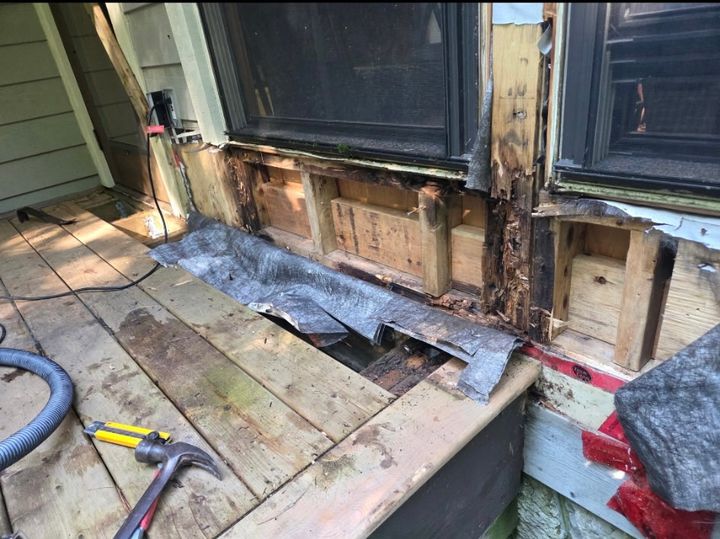
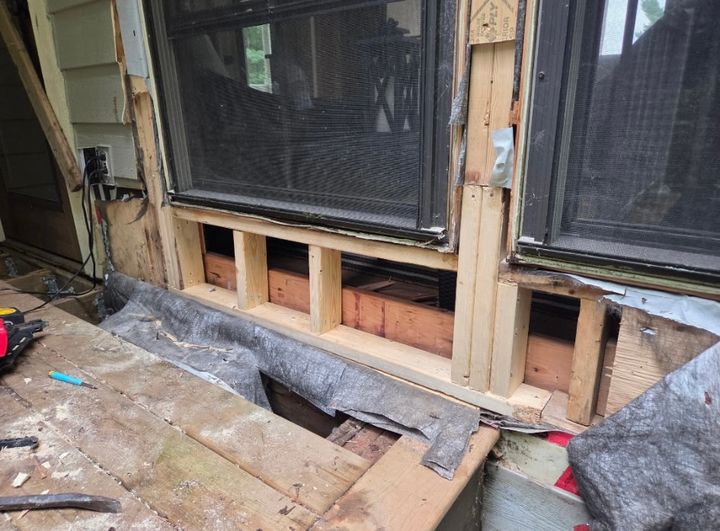
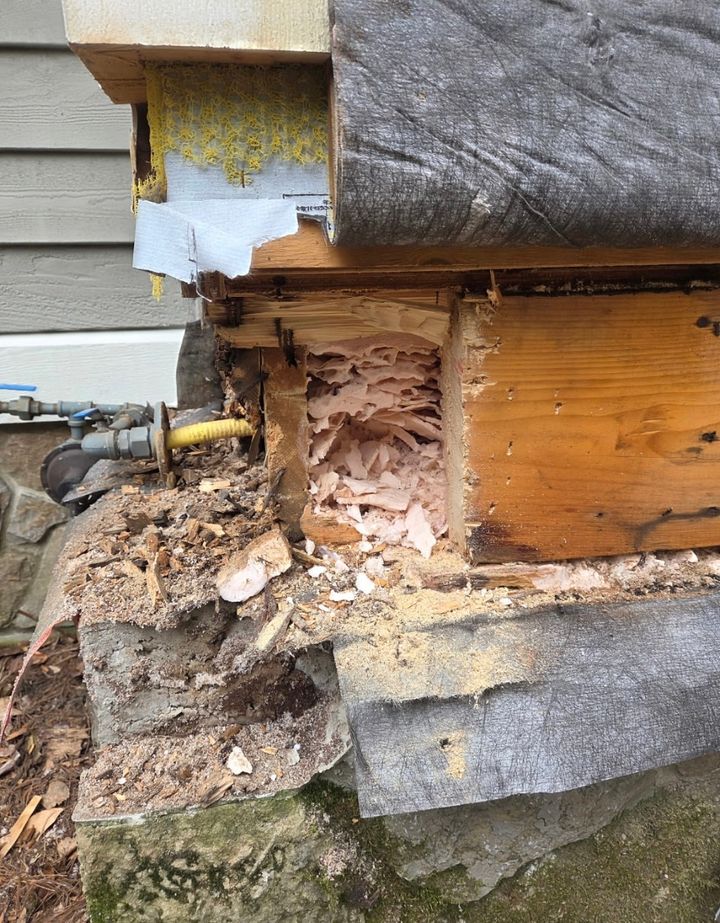
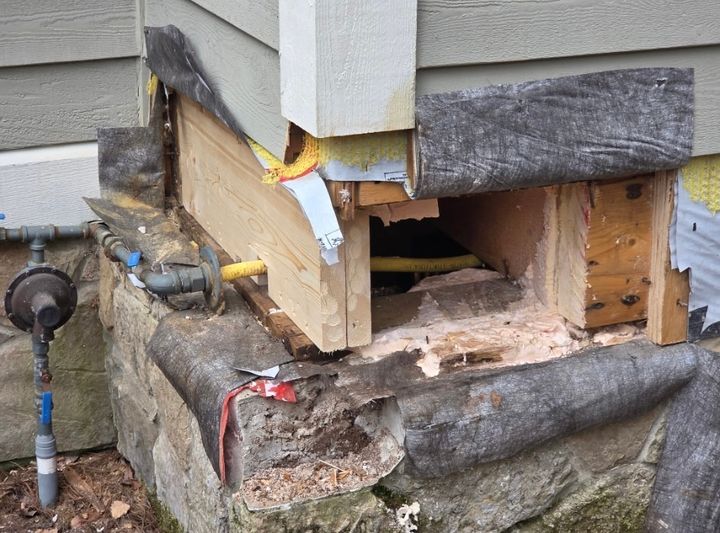
The photos below show two jobs. The first is a rotted sill and wall framing under two windows at the edge of a deck. The second shows rotted framing at a stone foundation corner. Both show the framing after the siding and sheathing came off, and after the new lumber went in.
Patch or repair?
| What you see | What it often means | What we do |
|---|---|---|
| Soft trim or fascia | Water has been running down the wall behind it | Replace the trim, then check the wall behind it |
| Siding that swells or stains near the bottom | Wet sheathing or sill plate | Open the wall and probe the framing |
| A deck that bounces or pulls from the house | Rotted ledger, joists or posts | Cut out the rot and rebuild the framing |
| A spongy floor near an exterior door | Wet subfloor and rim joist | Open the floor and replace the framing |
A filler or a coat of paint over soft wood hides the problem for a season and lets the decay keep going. We cut out wood until we reach material that is solid and dry.
Why we fix the water first
New lumber in the same wet spot rots again. Every rot job starts with a question: where does the water come from? The answer falls into one of five groups. Flashing around a window or door that has failed. A deck ledger bolted to the wall with no flashing above it. A roof edge with no drip edge or no gutter. Soil or a walkway that slopes toward the foundation. A roof leak that runs down inside the wall.
We fix that source as part of the job and tell you what we found.
What changes the size of a rot job
Two walls with the same amount of visible rot can need different work. Height matters, because a second-storey wall needs scaffold. Access matters, because a wall behind a deck or a hedge takes longer to open. A wall that carries a roof beam needs more shoring than a wall that carries only itself. A foundation corner adds masonry or concrete questions.
Season matters too. Frozen ground and snow slow outside work, and wet spring weather keeps a wall open longer than anyone wants. If a leak is active, we protect the opening the same day and finish when conditions allow.
Getting a price
Text photos of the damage to (705) 238-8634 and tell us the town. Photos of the outside, the soft spot and any stains on the inside tell us a lot. Rot repair prices depend on how far the damage goes and how much access the work needs, so a larger job gets a site visit first. Dylan Garland walks the job and sets the price. Quotes are free.
Rot repair often goes with new siding, a deck rebuild or a roof repair, and we can handle those on the same job.
Questions about rot repair
Do you repair structural rot in sills, joists and beams?
Yes. We shore up the building, cut out the soft wood back to solid material, find where water gets in and fix that, then rebuild with new lumber.
How can I tell if rot has reached the framing?
Push a screwdriver into the wood under a window, at the bottom of a wall or into a deck ledger. If it sinks in or the wood crumbles, the decay has reached the structure. Stains, a musty smell and a soft floor near an exterior door are other signs.
Can you tell me how bad it is from photos?
We can tell you how far it is likely to go. Rot travels along the grain, so we confirm the extent when we open the wall.
Do you do the siding after the rot repair?
Yes. We close the wall with sheathing, house wrap, flashing, trim and siding, so one crew handles the whole job.
Do you take rot repair on commercial buildings?
Yes. We take commercial contracts for businesses, resorts and lodges, rental and multi-unit properties, and property managers.
Keep reading
Where we do this work
- Rot repair in Muskoka
- Rot repair in Almaguin Highlands
- Rot repair in Sprucedale
- Rot repair in Huntsville
- Rot repair in Parry Sound
Other services
Request a free quote or call (705) 238-8634. Page updated October 27, 2026.